Friday, May 18, 2012

Presentation Tips: Inform, Engage & Move to Action video

The three things you need to do in every presentation to be successful. Enjoy this short video with valuable presentations tips.


Inform, engage and move to action - your presentation formula for success.

Presentation Tips on Twitter Presentation Skills Club on Facebook
Executive Speech Coach, Business presentation tips from George Torok, the Speech Coach for Executives

Share/Save/Bookmark

Wednesday, May 16, 2012

Should You Speak Behind a Lectern?

Maybe.

I suggest you do not use a lectern. Standing away from the lectern exposes your full body to the view of the audience. You appear more vulnerable, open and trustworthy. The added benefit is that you also appear more powerful and confident with your message.


How Can You Use a Lectern Effectively?

It is helpful to have a stand on which to put your notes. The problem is most speakers hide behind lecterns thereby greatly constraining important body language. 


I urge you to use as few notes as possible. Notes are essential only when you must read a prepared speech, or give a presentation in a foreign language. In that case, a lectern with a light and microphone will help you get through your talk smoothly.
          
Lecterns do make things look official. (Judges always hide behind a lectern.) The seriousness of your topic, the occasion, and the degree of formality in the audience may require that you use one. If so, plan to start and end behind it, but deliver most of your presentation away from the lectern with your whole body in full view.
          
There is one important rule about lecterns: Don't keep your hands gripped on the sides!  This draws listeners’ attention to your nervousness and restrains your body language. 


There are times when you might purposely grip the sides of the lectern to add emphasis to your words. Grasp the lectern only once or twice and lean toward the audience to make your critical points. The contrast helps emphasize what you are saying. 


Practice speaking comfortably without a lectern. If one is available, use it to hold your notes but do not hide behind it as you deliver your talk or you will reduce the power of your presentation.


Presentation Tips on Twitter Presentation Skills Club on Facebook
Executive Speech Coach, Business presentation tips from George Torok, the Speech Coach for Executives
Share/Save/Bookmark

Monday, May 14, 2012

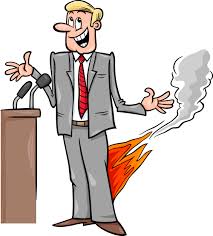
The Chicken Was Better than the Speaker


presentation chicken
The Speaker Read His Speech


What a disappointment. The man had the experience of excellence in both public service and entrepreneurship. In addition he had served the university in many roles over several decades. This was clearly a fascinating person.

You might think that he would have something interesting and engaging to say in his speech.

Instead, he parked himself behind the lectern and dutifully read the speech that someone else wrote for him. Cleary the speech writer wanted to demonstrate his vocabulary by including several ten dollar words. That doesn’t enhance comprehension, rapport or trust.

Occasionally the speaker shifted his stance, planted his hands in his pockets then withdrew them a few minutes later. It looked like nerves not intent. That is not making effective use of body language to support your message.

The presentation was disappointing, boring and uninspiring.

There was nothing personal about this speech. It started with an old joke that got a laugh – but it did not have a point – other than to discredit his credentials. That’s not the same as a personal self-deprecation.

There was no call to action to his audience. I’m not sure why he gave that speech.

We didn’t learn a thing about this fascinating person and I don’t know what he wanted us to do.

That makes for a failed presentation.

It was a wasted presentation. So much potential was lost. What a shame. Oh well, the chicken lunch was good.


Presentation Tips on Twitter Presentation Skills Club on Facebook
Executive Speech Coach, Business presentation tips from George Torok, the Speech Coach for Executives

Share/Save/Bookmark

Friday, May 11, 2012

How to Get Your Point Across in 30 Seconds or Less - book review


How to Get Your Point Across in 30 Seconds or Less

How to Get Your Point Across in 30 Seconds in Less by Milo O. Frank

I first read this book decades ago and have referred to it many times. My copy is marked with pen, highlighter and post it notes.

This book is short – only 120 pages. It will take you more than 30 seconds to read.

If you only read one book on communication skills this is the book to read.

I’ve suffered through many conversations and presentations from people who really needed to read this book. Perhaps you have suffered as well. Buy this book for anyone who loves to make noise without communicating.


What are the best ideas from this book?

You really can deliver an effective message in 30 seconds or less. The author offers several real examples.

You must first be clear about your objective before you can deliver a clear concise message.

The second step is to fully understand the motivation of your listener.

Knowing the first two steps, design your approach because your result is at the end of a process.

The hook is the emotional grabber that tips the argument in your favor. You must have a compelling hook. This is missed by most speakers.

Ask for action. An effective message must ask for action. Don’t hint. Ask! And be clear.

The best 30-second messages take lots of preparation and practice. Don’t wing it.

If you want to be a better communicator you must read this book.


Presentation Tips on Twitter Presentation Skills Club on Facebook
Executive Speech Coach, Business presentation tips from George Torok, the Speech Coach for Executives
Share/Save/Bookmark

Wednesday, May 09, 2012

The Difference Between Lecterns and Podiums

Lecterns versus Podiums

Lectern, not a podium
Many people confuse the words “lectern”, “podium”, “rostrum”, and “dais”. A lectern is the slanted-top high-desk that you as the speaker stand behind and use when reading your presentation notes. It can be placed in the middle of the stage or off to one side. To remember lectern think lecture.

A podium is a raised platform on which a speaker stands during a presentation. To remember podium think podiatrist - which is a foot doctor. You will want to use one, especially if you are short or there are more than three rows of chairs, so as to ensure everyone in the back of the room can see you. Standing on a platform will also dramatically increase your vocal projection.


A rostrum or dais is a larger platform or stage on which a head table might be placed during a formal dinner. 


Presentation Tips on Twitter Presentation Skills Club on Facebook
Executive Speech Coach, Business presentation tips from George Torok, the Speech Coach for Executives

Share/Save/Bookmark

Monday, May 07, 2012

What are your questions about presentations?


What questions do you have about presentations and public speaking?

Perhaps something that happened in a past presentation troubled you.

Maybe you are preparing for a future presentation.

What questions do you have?

Maybe I can help you. No guarantees. But I will try to answer your questions as best and helpful as I can. I won't write your speech and I won't write an essay. Post your questions in the comments and I will address them in a future blog post. You might also email me or post your questions on my FaceBook page (see link below).

Be clear and specific with your questions and I am more likely to address it quickly.

I look forward to your questions.

George Torok


Presentation Tips on Twitter Presentation Skills Club on Facebook
Executive Speech Coach, Business presentation tips from George Torok, the Speech Coach for Executives
Share/Save/Bookmark

Friday, May 04, 2012

Secrets of Power Presentations Book Review


Secrets of Power Presentations book review

Secrets of Power Presentations by Peter Urs Bender

This book first published in 1991 and I first read it around that time. Of all the books on presentation skills this book has contributed the most to shaping my public speaking skills.

I read this book when I was first exploring the world of public speaking. Many years later I met the author, Peter Urs Bender. He became my mentor as I entered the professional speaking business. We later co-authored a bestselling book together – Secrets of Power Marketing.

My original copy of this book is marked with Post-it notes and highlighter.

What are the best ideas from this book?

Your presentation is not only about the words you speak. It’s about the package that includes your words, delivery, body language, Audio Visual aids, and the environment.

When you’re green you grow. When you’re ripe you rot. This expression emphasizes the importance to be open to improvement; because you will never be the perfect presenter.

You can project more confidence than you feel. It’s only important how the audience sees you.

A good presentation should inform, entertain, touch emotions, and move to action.

Use shorter words and phrases to connect with your audience.

Summarize your speech notes on note cards. That way you will not read your speech but have the safety net of keyword notes.

Your speech is like a flight. The opening and close are like the take off and landing and hence critical to your success.

Details matter. As a presenter you are responsible for all the details – even if you think someone else should look after that. The audience will blame you for the things that go wrong.


What’s interesting about this book?

I enjoyed the simple and practical tips and lists.

The chapter on Environment is something that I have not seen in any other book on presentation skills. Chairs, windows and doors – oh my. I’ve found that these logistical tips about setting up the room made an incredible difference on the impact of my presentations.

The book is informative and surprisingly entertaining and inspiring - which was Bender's presentation style. It is sprinkled with motivational quotations plus Bender's own pithy insights.

There are so many helpful do’s and don’t's in this book that I imagine you will want to mark it up and even tear pages out so you have these gems readily accessible when you speak.


Presentation Tips on Twitter Presentation Skills Club on Facebook Executive Speech Coach, Business presentation tips from George Torok, the Speech Coach for Executives Share/Save/Bookmark

Wednesday, May 02, 2012

How to Attract the Eyes in Your Multi-Media Presentation

Two Key Principles of Eye Movement

principles of eye movement for presentations

Let’s look at two important principles of presenting with a computer and screen.

Our Eyes are Attracted to Light
Perhaps you have noticed when walking or driving at night that your eyes flash to the source of the brightest light.


You can use this attraction to light principle in the development and delivery of your presentation. When presenting you should always stand in the brightest light so people focus on you. Have the lights slightly dimmer at the back of the room. Bright lights at the back or side of the room will continually distract them.

On a screen it is easier to read lighter coloured letters on a darker coloured background. Our eyes are naturally attracted to the lighter letters – just where we want them to focus. (But don't use white on black. It's eye catching but difficult to read.) 


In contrast black letters on a white background is punishing to our eyes Because it is a light-emitting source our eyes are naturally attracted to the light background. Meanwhile we are forcing our eyes to focus on the black letters. This creates an internal conflict, which tires and annoys. The other pain this type of slide inflicts is that the eyes spend most of the time looking at the bright white light – which tires first the eyes and secondly the person.

Our Eyes are Attracted to Motion
For our cave-dwelling ancestors this was probably an important survival trait because movement signified either food or danger.


When you are speaking don’t have things moving on the screen because people will watch the movement and ignore what you say. Our brain can generally do one thing well at a time – watch or listen. Watching seems to take precedence. When you want people to look at the screen, gesture towards the screen then stand still. To recapture their attention after they have been studying the screen – take a step, stop, and then speak. Your movement draws their attention back to you. This principle explains why we easily get distracted by the speaker fidgeting or pacing. 


Presentation Tips on Twitter Presentation Skills Club on Facebook
Executive Speech Coach, Business presentation tips from George Torok, the Speech Coach for Executives
Share/Save/Bookmark

Friday, April 27, 2012

How to Deliver Superior Presentations video

Enjoy this 19 minute video of George Torok delivering his "How to Deliver Superior Presentations" to HAPPEN in Mississauga.

Notice the use of pausing. Note the facial expressions, change of voice and movement.


Presentation Tips on Twitter Presentation Skills Club on Facebook
Executive Speech Coach, Business presentation tips from George Torok, the Speech Coach for Executives
Share/Save/Bookmark

Wednesday, April 25, 2012

How an Assistant Can Help Your Presentation

Working with a Presentation Assistant


Presentation Assistant
An assistant can help your presentation in several ways.


Your assistant might:


  • Ask planted questions
  • Start the applause
  • Adjust the room temperature
  • Tell the group in the next room to quiet down
  • Distribute printed materials
  • Seat late arrivals
  • Handle interruptions
  • Open and close doors
  • Adjust lighting
  • Move chairs
  • Hold up props
  • Arrange for more coffee
  • Help set up and fix the equipment
  • Signal you regarding timing
  • Collect business cards


Depending on the nature of the task you might bring your own assistant or recruit a volunteer just before the presentation. In either case give them clear instructions. Provide the instructions in writing to be sure. You might even plan some simple hand signals to make communication smoother and seamless.

PS: Alfred is Batman's assistant.


Presentation Tips on Twitter Presentation Skills Club on Facebook
Executive Speech Coach, Business presentation tips from George Torok, the Speech Coach for Executives
Share/Save/Bookmark

Monday, April 23, 2012

Power Presentations Tip 60: Focus on Success Not Perfection


Focus on Success Not Perfection


Successful presentation not perfection

I believe that the perfect presentation doesn't exist.


Don't chase perfection in your speaking. Instead, seek to be successful every time you speak.


Perfection is unattainable and chasing it will slap you with a constant stream of frustration. A successful presentation is attainable and far more rewarding.


Start by defining your vision of success before every presentation. That definition of success can easily change depending on your growth as a speaker and the audience.


For a novice speaker, success might mean surviving the presentation without fainting. Everyone's got to start somewhere.


When you have passed that stage, define success in terms of "moving people". Define a successful by answering this question. What do you want people to think, feel or do when you are done?


If you want a single action (buy your product, hire you, approve your idea) then success will be easy to measure.


If you are speaking to a group where each listener will make and act on individual decisions then recognize that success might not be defined as 100%. This might be the case if you are instructing a class, speaking at a conference or managing staff.


When speaking to a group you might define success as moving 60% of the audience. Don't be upset by the 40% who didn't move. You still achieved success.


Don't beat yourself up over the flaws, mistakes or omissions in delivery if you attained your goal of moving people.


Yes, you probably want to improve your presentation skills. Keep doing that. But it's results that you want. That's the reason to speak.


If you want to be more successful in your presentations, then focus on success. Define the success of your presentation clearly and don't be distracted by the stumbles, tangents and turbulence along the way.


Forward this tip to your colleagues who want to be more effective presenters.


Call George Torok to arrange:

Presentation Skills Training for your team
One-on-one Personal Speech Coaching for your executives
An Engaging Keynote Speaker for your corporate meeting or association conference
Facebook Page
Twitter
For more frequent short tips follow me on Twitter


Presentation Tips on Twitter

Share/Save/Bookmark

Saturday, April 21, 2012

How to Keep Attention of Your Audience When Presenting: video tips

You can't hold the attention of your audience throughout your presentation. You need to keep recapturing it. Learn more in this Presentation Skills Tips video from George Torok.


View more Presentations Skills tips videos at http://www.youtube.com/presentationskills

Presentation Tips on Twitter Presentation Skills Club on Facebook
Executive Speech Coach, Business presentation tips from George Torok, the Speech Coach for Executives
Share/Save/Bookmark

Wednesday, April 18, 2012

Team Presentations - Are you on the same team?


Group Presentations

Abbott & Costello presentation team

Having more than one person presenting together can be effective. Note the success of the old comedy teams, sports commentators, TV news teams and radio show co-hosts. The second person provides colour, a different voice and a particular perspective.


You might employ a co-presenter for these reasons, but always be clear on the purpose of the second or third presenter in your team. They must serve a specific role that is clear to the audience. Otherwise it looks like the two of you are doing the same thing and therefore one of you is redundant.


Here are some possibilities:

Interview

You interview the chief engineer. In this case the chief engineer has both credibility and valuable information but might be a weak presenter. You keep the presentation focused with your questions and commentary.


Panel

You chair a panel of three or four experts. Again they offer credibility and perspective. You add colour and keep it focused. Whenever dealing with technical experts be prepared to challenge or interpret them for jargon and relevance.

In both of the above cases you are also the timekeeper. Tell your experts how long they have and be prepared to cut them off when their time is up. Don’t surprise them – tell them the rules up front then follow your own rules. Be sure to smile a friendly smile when you cut someone off.


Team Presentation

You are delivering a presentation to a new client and you want to bring along your Operations Manager and Chief Financial Officer.

Work Together
Be clear on why each presenter is included on the team. The purpose of each team member must be evident to the audience. Don’t overload your team. It should appear to be an effective team – not a flock of bleating sheep. This only confuses the audience and dilutes the power of your presentation.


One person should clearly be the lead presenter – to open and close and be the glue. Be sure to rehearse the full presentation together before the big day. Plan how each member will be introduced. Will the team leader introduce everyone or will each team member introduce himself? Rehearse a smooth transition from one team presenter to the next.


To help focus attention on the individual who is speaking the others should be seated or standing two feet behind the speaker. The team members who are not speaking should remain still and look at the one who is speaking. They should not distract the audience with movement, chatter or reading their own notes.


Presentation Tips on Twitter Presentation Skills Club on Facebook
Executive Speech Coach, Business presentation tips from George Torok, the Speech Coach for Executives
 Share/Save/Bookmark

Monday, April 16, 2012

What the &*+#@*


Is it okay to use or imply curse words when you present?

The person asking this question, suggested using slides with these words:

B#tch
B@st&rd
Sh*t

His purpose was to generate a laugh.

My answer to this question is “no, it’s not okay”.

The cost of the laugh is too high. For the sake of a possible few-second laugh you risk:

  • Offending at least one or more of your audience
  • Being permanently labelled as insensitive and obscene by your audience
  • Alienating some of your former listeners
  • Losing the respect of key decision makers
  • Losing the sale
  • Missing out on future opportunities
  • Tarnishing your expertise
  • Being remembered for the wrong things
  • Attracting people who think and speak in those terms
  • Being quoted for the wrong reasons


Just imagine that the media stepped into the room to witness your offensive message then left. What would they remember and report?


Presentation Tips on TwitterPresentation Skills Club on Facebook Executive Speech Coach, Business presentation tips from George Torok, the Speech Coach for Executives Share/Save/Bookmark

Saturday, April 14, 2012

Presentation Tips Video: How to Rehearse Your Speech

What's the best way to prepare your presentation? How should you rehearse?

Watch this video with George Torok to learn how.


Rehearse your presentation the right way and you will be a better speaker.
http://www.youtube.com/presentationskills1

Presentation Tips on Twitter Presentation Skills Club on Facebook
Executive Speech Coach, Business presentation tips from George Torok, the Speech Coach for Executives
Share/Save/Bookmark

Thursday, April 12, 2012

When and How to Use Props in Your Presentation


Props
Presentation Props

Props have the sensory appeal of making your presentation more visually pleasing and different. Difference is what interests us and what we tend to remember.

For example, if you travelled to work today – the same as always – you tended not to notice things nor remember anything specific. If something different happened – you woke up – noticed it and remembered it. You might even have told others about the different thing today. But you probably never told someone about your boring commute.

Similarly if your presentation is just as boring as all the rest, your audience night not wake up and remember any part of it – let alone tell others about it later.

A prop can provide that visual difference. Your product could be the prop you use or you might use a prop as a metaphor. This can be especially effective when explaining a service or concept. Laying your props out on a table can also serve as your speech notes.

Here are some sample props and possible messages.
Baseball – teamwork
Shovel – setting the groundwork
Tennis racket – importance of returning calls
Balloon – fun
Sundial – technological change

Another type of prop that can work very well is a simple magic trick. Don’t saw the boss in half. Just a simple card, rope or ring trick can help anchor your key message at the appropriate time. Be sure to rehearse it well and have a saver line ready in case the trick doesn’t work.

Use a prop if it helps clarify or anchor your message. If the prop does neither – don’t use it. You don’t want people wondering – “What was that all about?”


Presentation Tips on Twitter Presentation Skills Club on Facebook
Executive Speech Coach, Business presentation tips from George Torok, the Speech Coach for Executives
Share/Save/Bookmark

Tuesday, April 10, 2012

The Shocking Truth About What Your Teachers Told You About Answering Questions


4 lies about how to answer questions in your presentations. George Torok

How to Answer Questions in Business Presentations: Your Teachers Lied to You

If you remember your school teachers you probably recall a few favorites and some ogres. Most of them meant well but they gave you bad advice when it comes to you delivering a business presentation.

It was elementary and later high school where we were indoctrinated with the rules of answering questions. Some of those rules are misguided. You might need to break your blind obedience to these rules.


Lie #1: Never start a sentence with “Because”

It is grammatically correct to start a sentence with the word “because”. Your teachers simply wanted you to include a little more thinking and preamble into your reply so they lied to you.

Ignore this rule and feel free to start a sentence with “Because”. If it helps, recall the Beatles song, “Because” which starts with the phrase, “Because the world is round, it turns me on.”


Lie #2: You must answer the question now

No, you don’t. There might be times during your presentation when questions are simply interruptions. You don’t need to answer the question if that disrupts your message. I’m not saying you should ignore the question. Just be aware of the whole environment and flow of your presentation. Perhaps you nod at the person to acknowledge their request or you might simply say, I’ll take your questions in a few minutes.


Lie #3: You must answer the question

This is the most shocking truth that might be most difficult to believe. You don’t need to answer the question that was asked - at all.

You don’t need to answer it:

If it was a trap question:

When did you stop beating your dog?


If it was an attack question:

Do you deny that you stole from the treasury?


If it was a frivolous question:

Boxers or briefs?


How can you deal with these?

Remain calm and say:
  • Next question please.
  • Let’s move on to serious issues.
  • Please don’t waste our time with ridiculous questions.
  • The topic today is ...
  • The real question is ...


Lie #4: Look me in the eye when you answer my question

If you are talking to one person, follow this rule because you will look more believable.

However, when talking to a committee or an audience you are always talking to many even if one person asks most of the questions. Everyone in the room is listening to your answers and evaluating you. While answering a question in a group setting, make eye contact with a few people while delivering your answer to include them all in the conversation. After you have answered the question, look confidently back at the person who asked the question.

If you are questioned by a lawyer in a courtroom, look at the judge or jury while answering the question. They are the decision makers.


Presentation Tips on Twitter Presentation Skills Club on Facebook
Executive Speech Coach, Business presentation tips from George Torok, the Speech Coach for Executives
 Share/Save/Bookmark

Thursday, April 05, 2012

Watch the Body Language of Magician Marco Tempest

Perhaps magicians understand and illustrate body language best of all stage performers. When you want to improve the way you look during your presentation, you might be wise to observe a master magician perform. Why? Because they depend heavily on the messages that their body movements convey to support the perceptions of the audience.

Watch and enjoy this TED talk by illusionist, Marco Tempest as he talks about Augmented Reality. Notice how every body movement seems to enhance his performance and strengthen the effect. That's what your body language should do during your presentation. Instead many business presenters ignore the impact of their body language which often distracts or annoys their audience.

To get the full impact of Marco Tempest's body language watch at least part of this presentation with the sound off.

The second thing you will notice is the powerful use of visuals.


PS: As a presentation coach, the one thing that Marco Tempest might change in this presentation is to include a stronger closer line - instead of simply "Thank You".

He missed the opportunity to reinforce his message in his close.


Presentation Tips on Twitter Presentation Skills Club on Facebook
Executive Speech Coach, Business presentation tips from George Torok, the Speech Coach for Executives
Share/Save/Bookmark

Monday, April 02, 2012

Wanted: Person with Poor Communication & Presentation Skills

Poor Communication Skills job ad. George Torok
Ha, Ha, Just Kidding!
Have you seen a job ad asking for poor or mediocre communication skills?

Probably not. Think about that. What does that suggest to you?

You've probably seen many job ads asking for good, advanced or superior communication skills.

Let's be clear. Skills of any type are developed. Skills are not natural. Interest might be natural. But skills needs to be developed through learning, practise and coaching.

If you want to be a better presenter you must develop your presentation skills. What have you done about that lately?

There are three necessary steps to developing any skill set:

  • Learn the principles
  • Practice the techniques
  • Get expert guidance

The next time an interviewer asks you about your presentation skills, what will you say to demonstrate how you have addressed those three phases of skill development?

Communication and presentation skills are skills. You need to develop skills. You can't blindly claim ownership.

PS: By following this blog you will learn about the principles and tips that lead to effective techniques. You will still need to practice and get expert feedback from a coach, instructor or mentor.


Presentation Tips on Twitter Presentation Skills Club on Facebook
Executive Speech Coach, Business presentation tips from George Torok, the Speech Coach for Executives
Share/Save/Bookmark

Saturday, March 31, 2012

Discover how to deliver million dollar presentations